 |
| (Photo: Yusof Ishak Collection, Courtesy of National Archives of Singapore) |
|
| (Photo: Yusof Ishak Collection, Courtesy of National Archives of Singapore) |
On the 15th of February 1942, Lt General Arthur Percival signed the largest surrender in British history at Singapore. The city was supposed to be a fortress, but his force of 85,000 men had been defeated by just 35,000 Japanese troops.
Little over 2 months earlier Japanese forces had invaded Northern Malaya. Thanks to their advanced tactics and training, the Japanese advanced with incredible speed pushing the unprepared British back to Singapore in a so-called 'bicycle blitzkrieg'. When they crossed the Johore straits and captured the Bukit Timah heights above Singapore itself, Percival was forced to surrender.
So how did the Japanese defeat a numerically superior force? Why wasn’t Singapore an impregnable fortress? And could the British have held out?
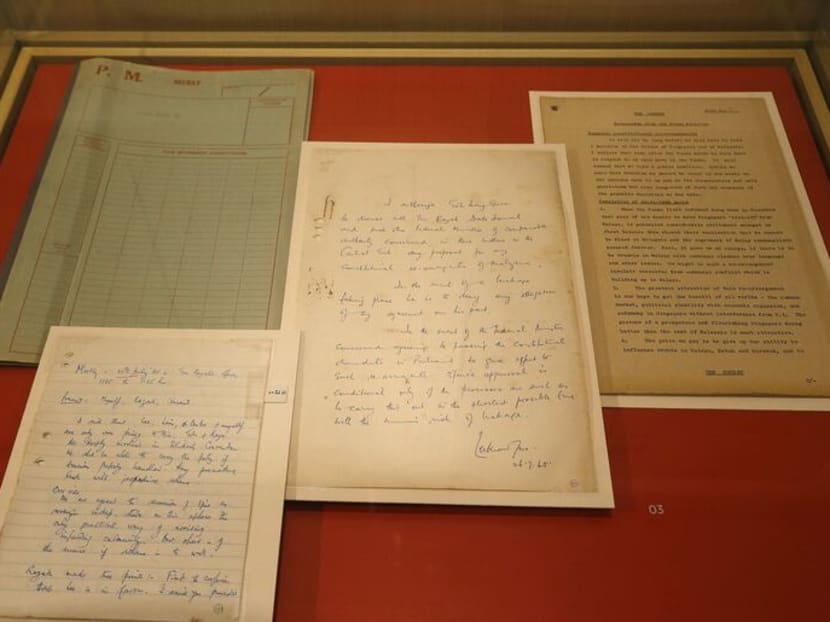 |
| Parts of the Albatross file on display at a special exhibition at the National Museum of Singapore in 2015. Raj Nadarajan/TODAY |
Today, Hokkiens and Teochews in Singapore are almost indistinct, mainly because everyone speaks English or Mandarin.
But in 1854, dialect groups were "badges" of identity and easily divided the respective groups, enough for them to take sides against the other:


|
Parts of the Albatross file on display at a special exhibition at the National Museum of Singapore in 2015. Raj Nadarajan/TODAY |
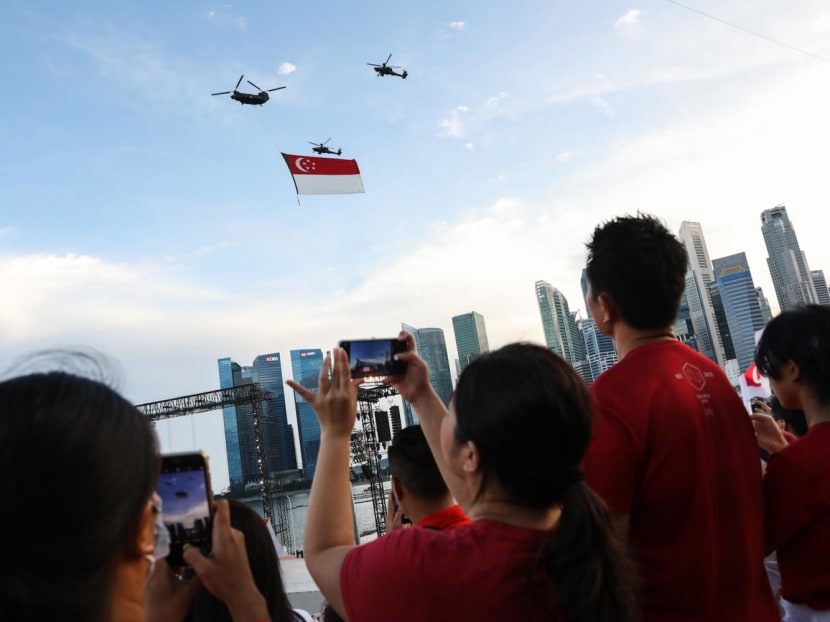 |
| As Singapore celebrates its birthday, let us recall the final words of Mr Lee at a press conference 57 years ago on August 9 over the separation: “We unite regardless of race, language, religion, culture.” Nuria Ling/TODAY |

The map above was drawn by James Franklin, the Assistant Quarter-Master General of the Bengal Army in Kolkata (Calcutta), What was the Assistant Quarter-Master General of the Bengal Army (Kolkata) doing drawing maps of Singapore?
